
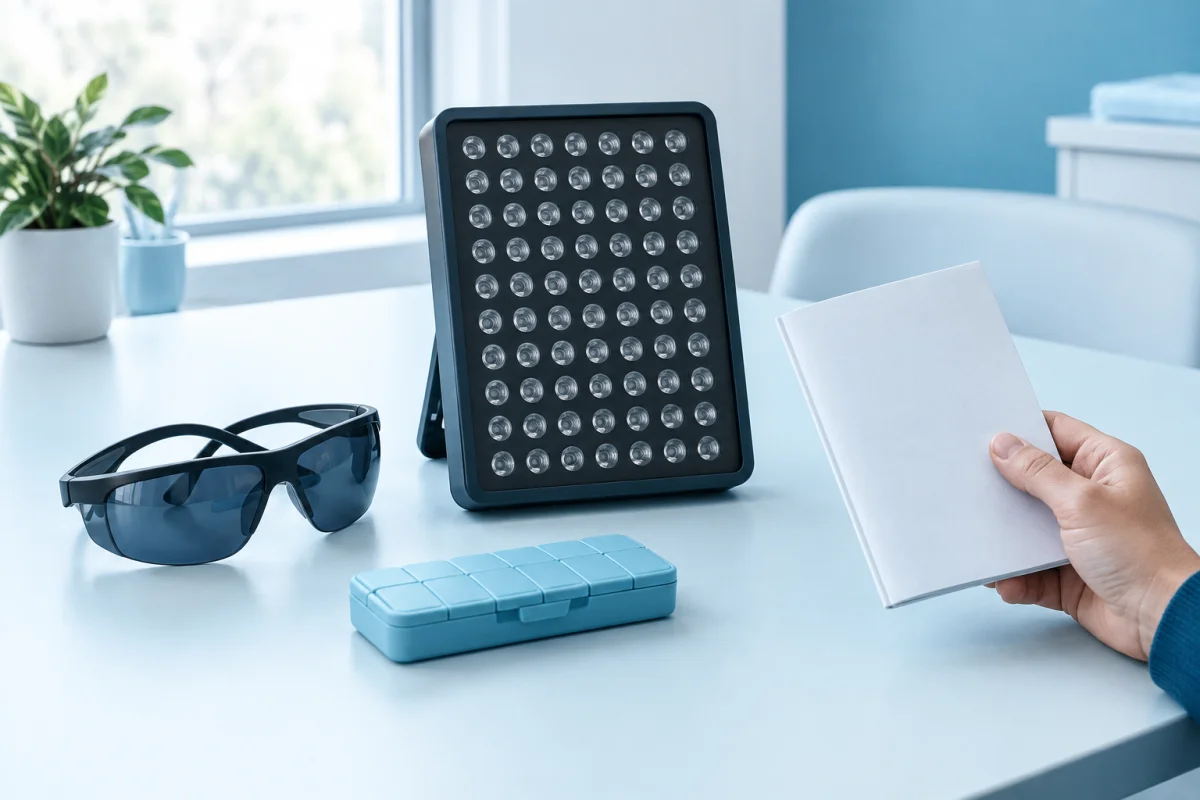
Check with a healthcare professional before using red light therapy if you take medicines that increase light sensitivity, have a light-sensitive condition, are pregnant, have photosensitive epilepsy, or have a tumor or ongoing cancer care. People with darker skin considering an at-home device should also ask a dermatologist about pigmentation risk.
These are reasons for an individual assessment—not six automatic bans. The decision depends on your health history, the device and the area being treated. The American Academy of Dermatology (AAD) provides guidance primarily for skin and at-home use, while Memorial Sloan Kettering Cancer Center (MSK) describes precautions within its clinical photobiomodulation, or PBM, program. Their guidance is not interchangeable with instructions for every red-light device. (AAD, MSK)
1. You take medicines or use topical products
Before starting, prepare a complete list of prescriptions, over-the-counter medicines, supplements, patches and creams. The AAD warns that medicines that increase light sensitivity may make red light therapy unsuitable. MSK also asks patients to disclose their medicines before PBM treatment. This does not mean every medicine or topical product is a contraindication. (AAD, MSK)
A general online list of “prohibited medications” cannot settle whether your particular medicine and device are compatible. Ask the prescribing clinician or pharmacist to review the combination. Do not stop a prescribed medicine on your own to use red light therapy.
A useful question is: “Does anything I take or apply to my skin change whether I should use this specific device?”
2. You have a condition that makes your skin sensitive to light
Tell a dermatologist about any diagnosed light-sensitive condition before treatment. The AAD specifically identifies lupus as a condition that can worsen with red-light exposure. (AAD)
Do not assume that a device is suitable simply because it is marketed for home use or described as gentle. Explain your diagnosis and any previous reactions to light, and bring the device information if you have it. That gives the dermatologist something more specific to assess than the broad label “red light therapy.”
3. You are pregnant, might be pregnant or plan to become pregnant
Discuss treatment with your pregnancy-care clinician before starting. MSK asks patients to disclose pregnancy or pregnancy plans. Within its own PBM protocol, it avoids abdominal exposure during pregnancy because there is insufficient evidence about fetal safety. (MSK)
Insufficient safety evidence is not the same as proof of harm. It is also not evidence that every device, treatment area or exposure is safe. MSK’s abdominal-exposure precaution is an institutional clinical rule, not a universal set of instructions for consumer and wellness devices.
Ask whether you should postpone treatment rather than choosing your own modified settings.
4. You have photosensitive epilepsy
If flashing or flickering light has triggered seizures, speak with the clinician managing your epilepsy before using a light-based device. MSK includes photosensitive epilepsy among the conditions patients should disclose before PBM treatment. (MSK)
Bring the device name and instructions to that conversation. Do not assume that all red-light devices operate in the same way, or that changing a setting yourself resolves the concern. The practical next step is a device-specific discussion—not a trial session to see what happens.
5. You have a tumor or are receiving cancer care
Ask your oncology team before beginning red light therapy, and identify exactly where you intend to use it. MSK asks patients to disclose tumors and avoids exposure near tumors within its protocol because evidence is insufficient. (MSK)
That does not mean cancer is a universal prohibition against all PBM. MSK itself uses PBM in selected cancer supportive-care settings. The distinction is between treatment selected by an oncology team for a particular purpose and independently using a wellness or home device. (MSK)
Your oncology team should guide whether treatment is appropriate, where it may be used and whether it fits your current care.
6. You have darker skin and are considering an at-home device
Darker skin is not an automatic contraindication. However, the AAD recommends consulting a dermatologist before at-home red light therapy because visible light can contribute to hyperpigmentation, or dark spots, in darker skin tones. (AAD)
This is particularly worth discussing if your goal is to improve uneven pigmentation. Ask whether the proposed device is appropriate for your skin and what changes should prompt you to stop and seek advice. Do not assume that a device promoted for a more even complexion is necessarily the right option for you.
Safety steps apply even if none of these situations fits
Not falling into one of these groups is not a blanket clearance for every device. For at-home skin treatment, the AAD advises following the device’s directions and using its specified eye protection. Do not substitute sunglasses for required protective goggles. The AAD also notes that long-term effects on skin and hair remain uncertain. (AAD)
Avoid borrowing treatment times, distances or schedules from a different product. Use the instructions for the actual device rather than a generic online routine.
If you have pain or discomfort after treatment, contact your healthcare professional rather than pushing through it. This is also the follow-up advice MSK gives its PBM patients. (MSK)
What to bring to a red light therapy discussion
Prepare a short checklist:
- Your treatment goal: What are you hoping to address, and on which body area?
- Your complete medication and product list: Include supplements, patches and creams.
- Relevant health history: Include light-sensitive conditions, pregnancy, photosensitive epilepsy and cancer care.
- Device information: Bring the name, model and instructions if you are considering an at-home product.
- Your questions: Ask whether to proceed, postpone or speak with another treating clinician first.
For practice-specific questions in McKinney, visit the red light therapy page for Dr. Ali Chiropractic and Wellness Center. You can call (214) 945-3911 or email the practice to ask what information to bring before discussing treatment. The practice is located at 2001 Auburn Hills Pkwy Ste 101, McKinney, TX 75071.
This article is general education, not individual medical clearance. It draws on U.S. AAD guidance updated September 13, 2024, and MSK patient guidance updated May 16, 2025. These sources address different treatment settings and are not a comprehensive contraindication list. Follow device instructions and seek advice from the clinician familiar with your health.